Declaring the measurement boundary: the IETF profiles draft
Part of a series on the IETF drafts for benchmarking LLM serving. Start with the overview.
Time to first token is a single phrase that can mean several different numbers. It depends on where you start the clock. Do you include the gateway. Do you include the firewall inspection. Do you include the network hop. Each choice gives a different value, and a benchmark that does not say which choice it made cannot be compared with another. The third IETF draft fixes this with profiles. It is an individual submission to the IETF Benchmarking Methodology Working Group with no formal IETF endorsement.
What a profile is
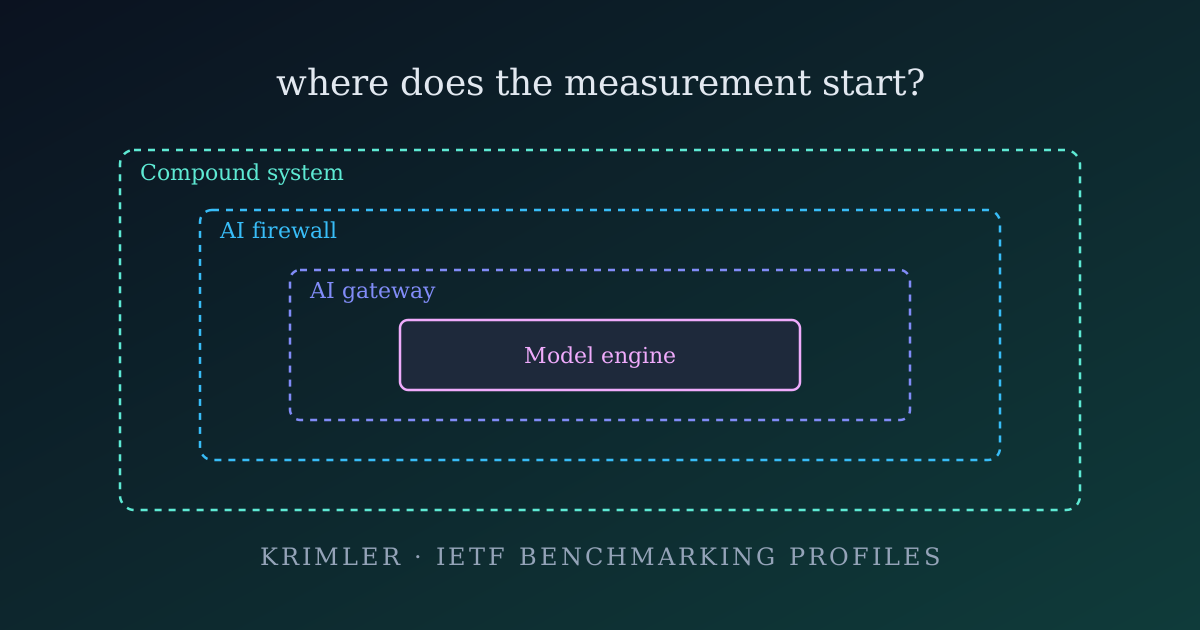
A profile binds the vocabulary and the procedures to a concrete role in the system and a concrete workload pattern. Its job is to declare the boundary. A profile says exactly where a measurement starts and stops, so two results taken under the same profile are measuring the same thing.
The profiles it defines
The draft defines infrastructure profiles for the distinct roles in a serving stack.
- Model engine. Raw inference: prefill, decode, and management of the key-value cache.
- AI gateway. The overhead of routing, authentication, and caching.
- AI firewall. The latency and accuracy of security inspection, including detection rates and false positive rates.
- Compound system. End-to-end completion for orchestrated multi-step workflows such as retrieval-augmented generation and agents.
It also defines workload profiles for how the system is driven, including a chatbot pattern, which is multi-turn and human-paced, and a compound workflow pattern, which is multi-step and machine-paced.
The draft specifies profiles only. It introduces no new metrics and no thresholds. It is the layer that makes the terminology and the methodology comparable across real deployments, where a request passes through several components before it reaches the model.
Why it matters
Production systems are built from a gateway, a firewall, an engine, and more. Most published benchmarks never say which of these the numbers include. Profiles remove that ambiguity by making the boundary an explicit, declared part of every result.
Read the draft
Performance Benchmarking Profiles for Large Language Model Serving Systems.